DAX HANDBOOK
4.3 Mixed functions

If you wish to follow along, you can find PBIX/Excel files at the bottom of the article. 

Authors

Krešimir Ledinski

Krešimir Ledinski

Microsoft certified expert in the field of Business Intelligence. His biggest passions are DAX, M, and data modeling.

Kristian Radoš

Kristian Radoš

Experienced data analyst. Advanced in SQL, PowerApps and M language.

Explanation

Mixed functions are the ones that can form group-by of multiple columns and define different data granularities while having the ability to invoke row context over the newly formed tables. The most important one is SUMMARIZE.

SUMMARIZE is mostly used as a replacement for VALUES function when we need to create crossjoin of multiple columns from the model while accepting filter context. VALUES function can only accept a single column or the whole table as an argument, but if we need to form a table from multiple columns then SUMMARIZE is the preferred way to go.

SUMMARIZE syntax:

SUMMARIZE (Table, [GroupByColumn1, GroupByColumn2, …], [[ColName1], expression, [ColName2], expression, …])

  • The first argument is the table from which we wish to group columns.
  • The second type of argument is a list of columns we wish to include in a grouped virtual table.
  • The third type of argument is defining the new column we want to add to the virtual table with the expression that will be evaluated in a row context of the summarized table. The 3rd argument is rarely used. If we need to add an additional virtual column to the SUMMARIZE function, we should use ADDCOLUMNS function instead because, in most cases, the latter produces a faster query plan.
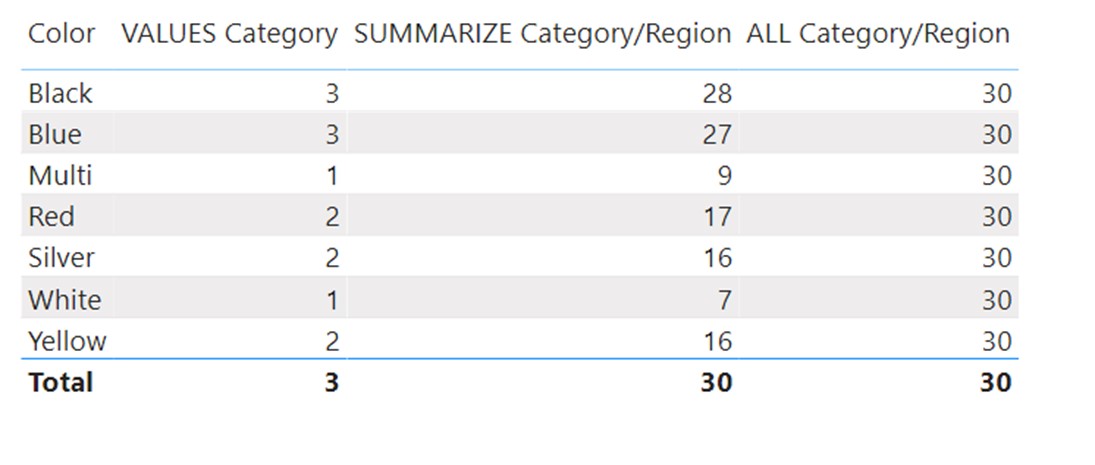
VALUES_Category = COUNTROWS(VALUES(Sales[CategoryName]))

VALUES can only accept a single column or a whole table as an argument, which limits its application. It accepts filter context.

ALL_Category/Region = COUNTROWS(ALL(Sales[CategoryName],Sales[SalesTerritoryRegion]))

ALL function can be used with multiple columns, but its side effect is that it ignores filter context

SUMMARIZE_Category/Region = COUNTROWS(SUMMARIZE(Sales,Sales[CategoryName],Sales[SalesTerritoryRegion]))

SUMMARIZE is the best replacement for the VALUES function when we need to cross-join multiple columns. It does that while accepting filter context.

SUMMARIZE notes:
Like with the ADDCOLUMNS function, its usefulness becomes clear after learning the power of the CALCULATE function.


SUMMARIZE can access any table in a data model connected to the table defined in the first argument, as long as that table has a one to many relationship with the main table. The data model concept will be explained in the following chapter.

Materials

We wish to create the best possible content!

If you are a novice looking for a better explanation of any element of the topic, feel free to comment on the part you didn't quite understand!

If you are an expert in DAX and believe certain topic lacks important internals, your comments are more than welcomed!

COMMENTS

Subscribe
Notify of
guest
0 Comments
Inline Feedbacks
View all comments

OUR SERVICES

Prefer live training or consultations?

Table of Content

Table of Content

GET LATEST BI NEWS TO YOUR INBOX

Receive the latest updates on all business analyst news across all platforms.

By subscribing you are agreeing to our Privacy Policy.

Related blog posts

Who Visits Slovenia and When

Which foreign tourists visit Slovenia the most, and when do they come? Experimental data from the Statistical Office of the Republic of Slovenia, based on foreign mobile users roaming on Slovenian networks, offers a detailed view. Top Visitors According to the data, tourists from Austria (13.3%), Germany (13.1%), and the...

Read more

Where Slovenians Travel and When

Where do Slovenians like to travel, and when do they go? Experimental data from the Statistical Office of the Republic of Slovenia, based on mobile users roaming in foreign networks, provides clear answers. Top Destinations There are no surprises at the top. Croatia remains the number one destination for Slovenians....

Read more

Newborn Names – A Growing Pool

As the range of consumer choices has expanded over the past 30 years, so has the range of names parents choose for their children. Name Diversity According to data from Republic of Slovenia Statistical office in 1999 there were 187 different female and 190 different male newborn names. By 2024,...

Read more

Newborn Names – Getting Shorter

If it feels like newborn names are getting shorter, you are not imagining it. Past Trending Data from the Statistical Office of the Republic of Slovenia show that in 1992 the average name length was 5.2 letters for girls and 4.9 letters for boys. By the early 2020s, the average...

Read more
0
Would love your thoughts, please comment.x
()
x
Scroll to Top