DAX HANDBOOK
4.4 Table to Scalar Transformation

If you wish to follow along, you can find PBIX/Excel files at the bottom of the article. 

Authors

Krešimir Ledinski

Krešimir Ledinski

Microsoft certified expert in the field of Business Intelligence. His biggest passions are DAX, M, and data modeling.

Kristian Radoš

Kristian Radoš

Experienced data analyst. Advanced in SQL, PowerApps and M language.

Explanation

All table functions have one special feature. If the result of the table function returns exactly one row and a single column, its result is automatically transformed into a scalar which can be shown in a visual.

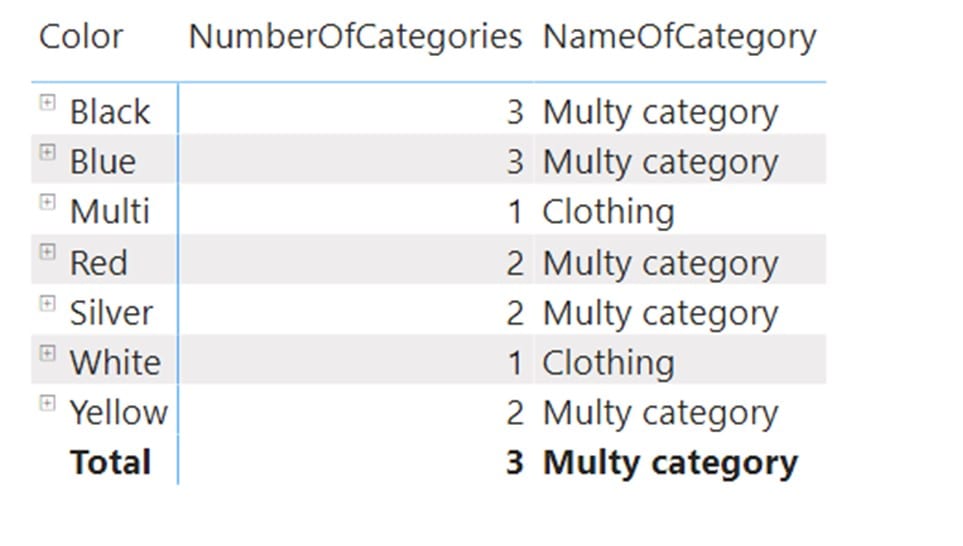
NumberOfCategories = COUNTROWS(VALUES(Sales[CategoryName]))
NameOfCategory = IF(COUNTROWS(VALUES(Sales[CategoryName]))=1,VALUES(Sales[CategoryName]),"Multi category")

The [NumberOfCategories] is a measure that counts the number of unique CategoryNames from the Sales table, taking into account the Color filter on the visual. We can see that Multi and White colors have only one type of CategoryName. VALUES function used a single column as an argument, and that column, when filtered by colors Multi and White, returns only a single row. When a table function returns only one row and one column, its result is automatically transformed into a scalar which can be represented in a visual. That’s why we receive “Clothing” text as a result of a measure for the mentioned colors.

Important

When using this technique, it’s extremely important to always secure the Measure to perform scalar transformation only in case the 1 row 1 column rule is secured. In our case, we implemented an IF condition, which counts the number of rows in a table that the VALUES function returns. If count does not equal to 1, then the text returned in a visual is “Multi category”. If the value equals 1, it means it’s safe to make table to scalar transformation and we simply return the result of the VALUES function.

Table to scalar transformation occurs for every table function which, after evaluation, returns a single row and a single column.

[NameOfCategory] measure can be also written with a sugar syntax function SELECTEDVALUE(ColumnName, “Alternate Result”).

Materials

We wish to create the best possible content!

If you are a novice looking for a better explanation of any element of the topic, feel free to comment on the part you didn't quite understand!

If you are an expert in DAX and believe certain topic lacks important internals, your comments are more than welcomed!

COMMENTS

Subscribe
Notify of
guest
0 Comments
Inline Feedbacks
View all comments

OUR SERVICES

Prefer live training or consultations?

Table of Content

Table of Content

GET LATEST BI NEWS TO YOUR INBOX

Receive the latest updates on all business analyst news across all platforms.

By subscribing you are agreeing to our Privacy Policy.

Related blog posts

Newborn names – getting shorter

If it feels like newborn names are getting shorter, you are not imagining it. Past trending Data from the Statistical Office of the Republic of Slovenia show that in 1992 the average name length was 5.2 letters for girls and 4.9 letters for boys. By the early 2020s, the average...

Read more

Newborn names – changing popularity over time

As with most things in life, the names parents give their children change over time. Names for girls According to data from Republic of Slovenia Statistical office Eva is the most common name given to newborn girls in the period 1992–2024. It was especially popular in the 2000s, ranking third,...

Read more

We have expanded our team again!

We are extremely pleased to announce that Luka has joined our team, with over 20 years of experience in data, analytics and business decision-making. He built his career in leading international companies such as Procter & Gamble, Nielsen and L’Oréal, where he gained strong analytical thinking, a strategic approach and...

Read more

Ponovno smo proširili naš tim!

Iznimno nam je drago podijeliti da nam se u timu pridružio Luka, s više od 20 godina iskustva u radu s podacima, analitici i donošenju poslovnih odluka. Svoju karijeru gradio je u vodećim međunarodnim kompanijama poput Procter & Gamble, Nielsen i L’Oréal, gdje je stekao snažno analitičko razmišljanje, strateški pristup...

Read more
0
Would love your thoughts, please comment.x
()
x
Scroll to Top